Estate agency has always been built on experience. Most agents learn on the job, pick things up quickly, and develop strong commercial instincts. But in 2026, that alone is no longer enough. With continued reform building on the Employment Rights Act 1996 and the direction of travel set by the Employment Rights Act 2025, the expectation is clear:
Employers must demonstrate structured, consistent and fair management from day one.
And that starts with training.
The shift from experience to evidence
In the past, many agency businesses relied on shadowing and “Sitting next to the best negotiator” and practical learning through doing. Whilst that still has value, it doesn’t create evidence.
And in today’s employment environment, evidence matters:
- Evidence that staff were trained
- Evidence that expectations were clear
- Evidence that support was provided before decisions were made
Without this, even well-run businesses can be exposed.
Regulation is coming — and it changes expectations
The direction of travel across the property sector is towards greater professionalisation and accountability.
Whether through employment law changes or wider industry reform (including anticipated regulation of agents), the message is consistent – You will need to show how your staff are trained — not just assume they are competent.
This is a key moment for agency businesses.
Not something to react to later — but an opportunity to get ahead now.
Induction training is no longer a “nice to have”
One of the biggest gaps in estate agency is structured onboarding.
New starters are often:
- Given logins
- Shown systems
- Expected to perform quickly
But without a clear pathway, this creates:
- Inconsistent knowledge
- Poor compliance
- Slower performance
- Higher staff turnover
A structured induction programme changes this completely.
It should:
- Set clear expectations from day one
- Cover legal and compliance essentials
- Build commercial skills alongside knowledge
- Provide a consistent experience across the business
The real value of learning pathways
Training works best when it is not a one-off session, but a clear pathway.
This means:
- Role-specific training (negotiator, valuer, property manager)
- Progressive learning stages
- Blended content (practical + compliance)
For example:
A new negotiator pathway might include:
- Compliance basics (AML, consumer law such as the DMCC and Data Protection)
- How to handle enquiries and viewings
- Valuation support and pricing conversations
- Sales progression process awareness
This creates confidence — and consistency.
If you can’t track it, you can’t prove it
One of the biggest risks for agencies is not a lack of training —
but a lack of visibility.
If a complaint arises, or a decision is challenged, you need to be able to show:
- What training was completed
- When it was completed
- Who has (and hasn’t) engaged
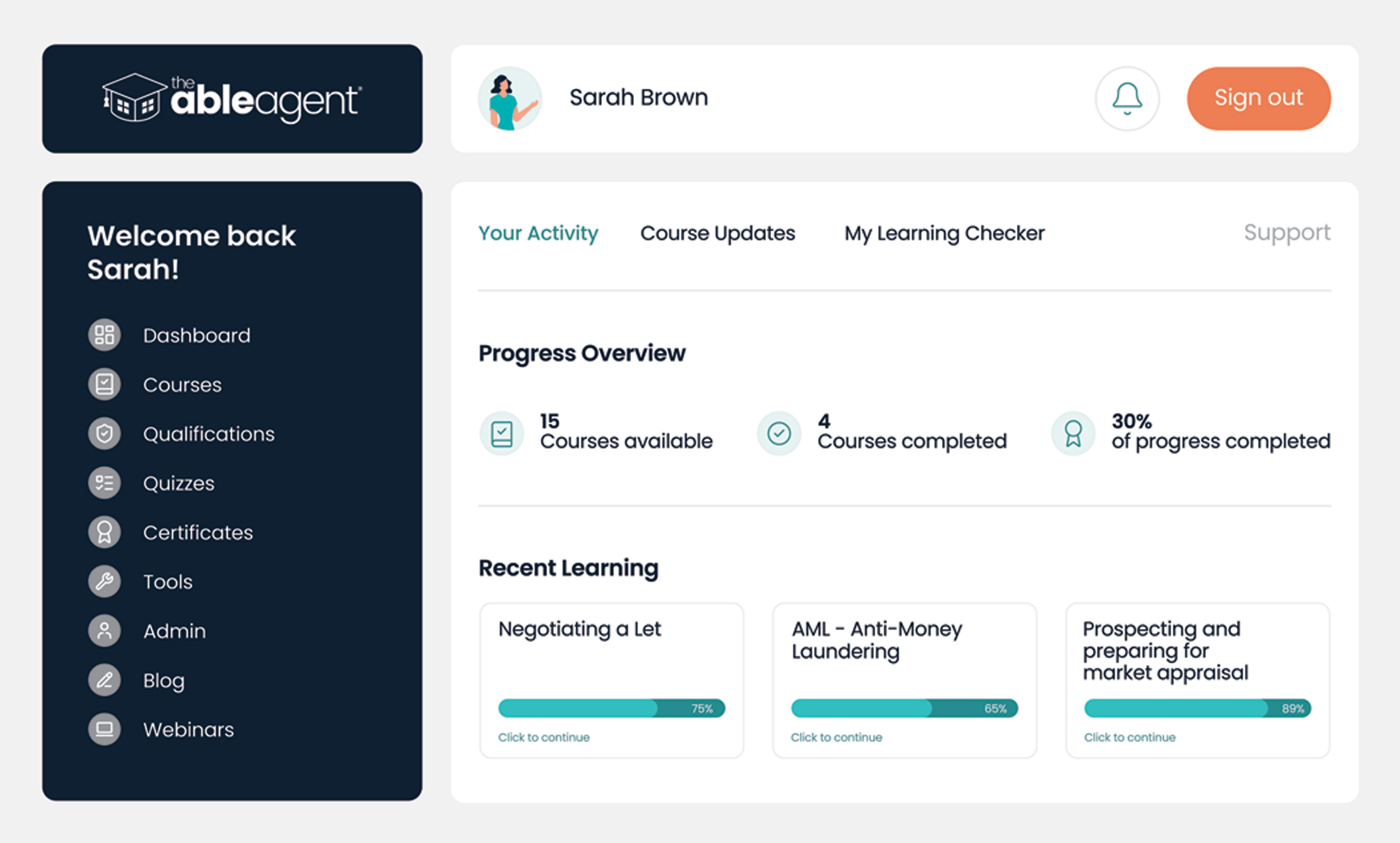
This is where reporting becomes critical. Being able to monitor course completion, knowledge gaps and engagement levels
turns training from a “tick box” into a management tool.
Training is not just about compliance — it drives performance
There is often a misconception that compliance training slows teams down. In reality, the opposite is true because well-trained teams:
- Handle clients with more confidence
- Spot opportunities others miss
- Reduce fall-throughs
- Justify fees more effectively
- Build stronger reputations
Training is not separate from performance — it underpins it.
A practical shift for agency leaders
The most forward-thinking agencies are already making changes.
They are:
- Moving away from informal training
- Creating structured induction programmes
- Building ongoing development pathways
- Using reporting to monitor progress
This doesn’t need to be complicated.
But it does need to be intentional.
The industry is changing. Not overnight — but steadily and clearly and with that comes a new expectation – That training is visible, structured and measurable.
For estate and letting agencies, this is not just about staying compliant.
It is about:
- Protecting your business
- Supporting your team
- Creating a professional, scalable operation
Because in 2026, the agencies that invest in training won’t just reduce risk — they will outperform.